
Models, stimuli, and controls
The accuracy drop under short chain-of-thought (CoT) comes from what the rationale says, not from its length, turn format, or visual forgetting. We evaluate 15 open VLMs (2B–38B) and 6 frontier closed models on binary depth and spatial questions using a forced readout, which reads the higher-probability option letter at the appended assistant prefix "Answer: (" immediately after the question (Direct answering, or Direct) or after a greedy step-by-step rationale (CoT). On our 2,850-item main spatial pool, short CoT significantly lowers accuracy in 6 of 8 main-pool open models (−1.4 to −9.2 pts; only InternVL3.5-8B gains +2.5 pts).
To test whether this drop comes from extra tokens or turn structure rather than what the rationale says, we insert neutral prose matching the rationale length in the same assistant turn or before closing the turn. Same-turn filler can shift option priors by up to −9.3 pts, but closing the assistant turn first keeps all 8 models within −2.3 to +0.7 pts of Direct (5 small shifts remain statistically detectable, largest −2.3 pts). Re-showing the image or restating the question after the rationale recovers at most 0.8 pts each (≤ 1.5 pts combined), showing that the accuracy drop comes from the written content rather than visual forgetting.
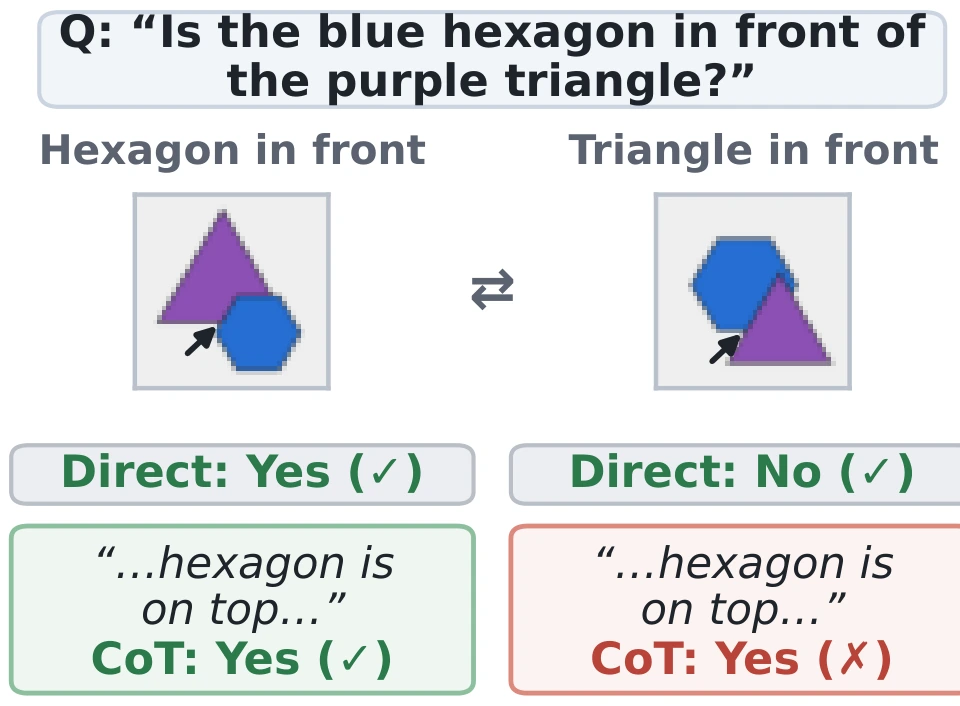
"Answer: (") answers accurately but short CoT answers wrongly.
| Condition | Qwen2.5-VL 3B |
Qwen2.5-VL 7B |
InternVL3 8B |
Phi-3.5 Vision |
Molmo 7B-D |
Qwen3-VL 8B |
Qwen3-VL 8B-Think. |
InternVL3.5 8B |
|---|---|---|---|---|---|---|---|---|
| Direct (%) | 80.3 | 85.9 | 89.6 | 76.4 | 74.5 | 91.1 | 92.8 | 83.3 |
| CoT Δ vs. Direct (pts) | −8.8* | −3.9* | −5.1* | −9.2* | −1.7 | −3.5* | −1.4* | +2.5* |
| Filler(|R|) same turn Δ | −2.5 | −9.3 | −2.7 | −5.7 | −1.9 | +0.8 | – | +0.5 |
| Filler(|R|)+turn Δ | −0.5 | +0.7* | −1.0* | −2.3* | −0.1 | +0.5* | 0.0 | +0.7* |
| CoT+turn / +restate (%) | 71.8 / 72.3 | 82.1 / 82.6 | 84.9 / 84.9 | 67.2 / 68.0 | 72.6 / 73.3 | 87.5 / 87.6 | 91.4 / – | 85.9 / 86.2 |
| CoT+reimage / +both (%) | 72.0 / 72.9 | 82.2 / 83.0 | 84.5 / 86.0 | 68.0 / 68.2 | – / – | 87.6 / 87.6 | – / – | 85.9 / 86.5 |
Qwen3-VL-8B-Thinking uses its native thinking trace (mean 307 tokens) and length-matched turn-closed filler. Excluding the size-confounded Synthetic Depth stress test, three models still lose accuracy significantly and one gains.
Model cohort roster (all 15 open VLMs and 6 frontier closed models)
Core seven open instruct (≤ 8B): Qwen2.5-VL-3B, Qwen2.5-VL-7B, InternVL3-8B, Phi-3.5-Vision, Molmo-7B-D, Qwen3-VL-8B, InternVL3.5-8B.
Reasoning-tuned open (3): Qwen3-VL-8B-Thinking, MiMo-VL-7B-RL, GLM-4.1V-9B-Thinking.
Larger instruct & scale ladder (5): Qwen3-VL-32B, Qwen2.5-VL-32B, InternVL3.5-38B (all 13 above tested on the cue-factorial set), plus Qwen3-VL-2B and Qwen3-VL-4B on occlusion twins.
Frontier closed APIs (6): Claude Opus 5.5, GPT-6-Astra, Gemini-4-Argon, Qwen3.8-Max, HY4, DeepSeek-V4.1-Flash.
Writing re-weights visual cues
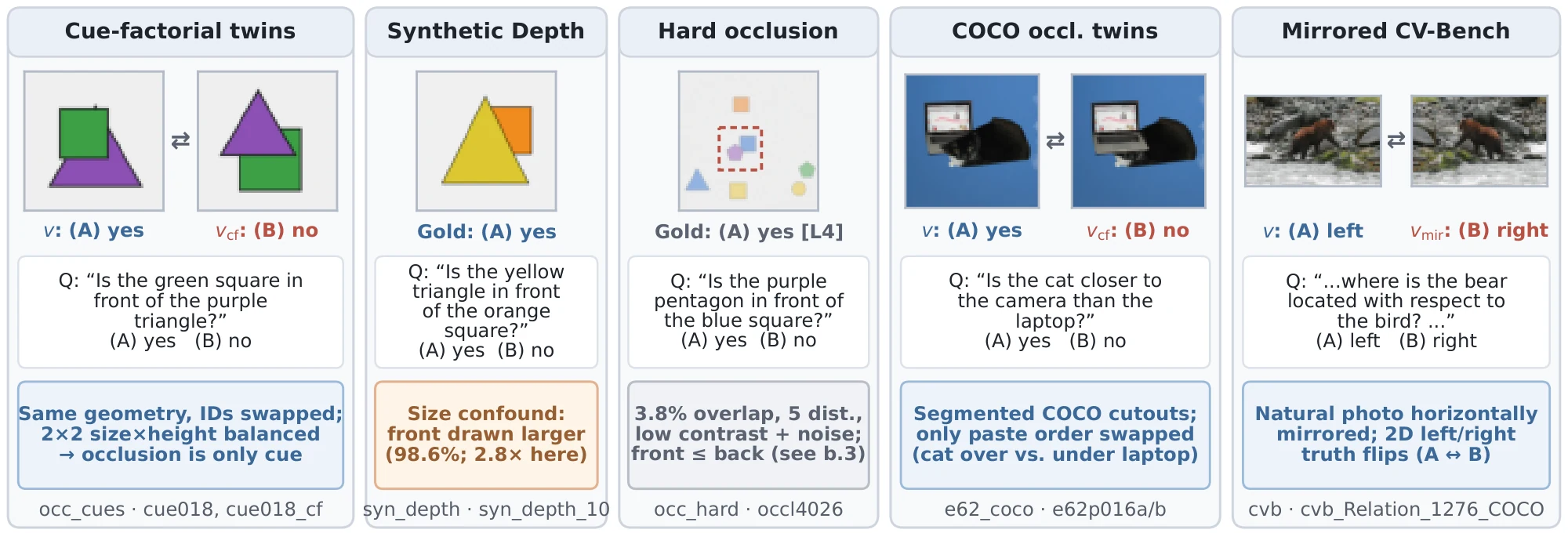
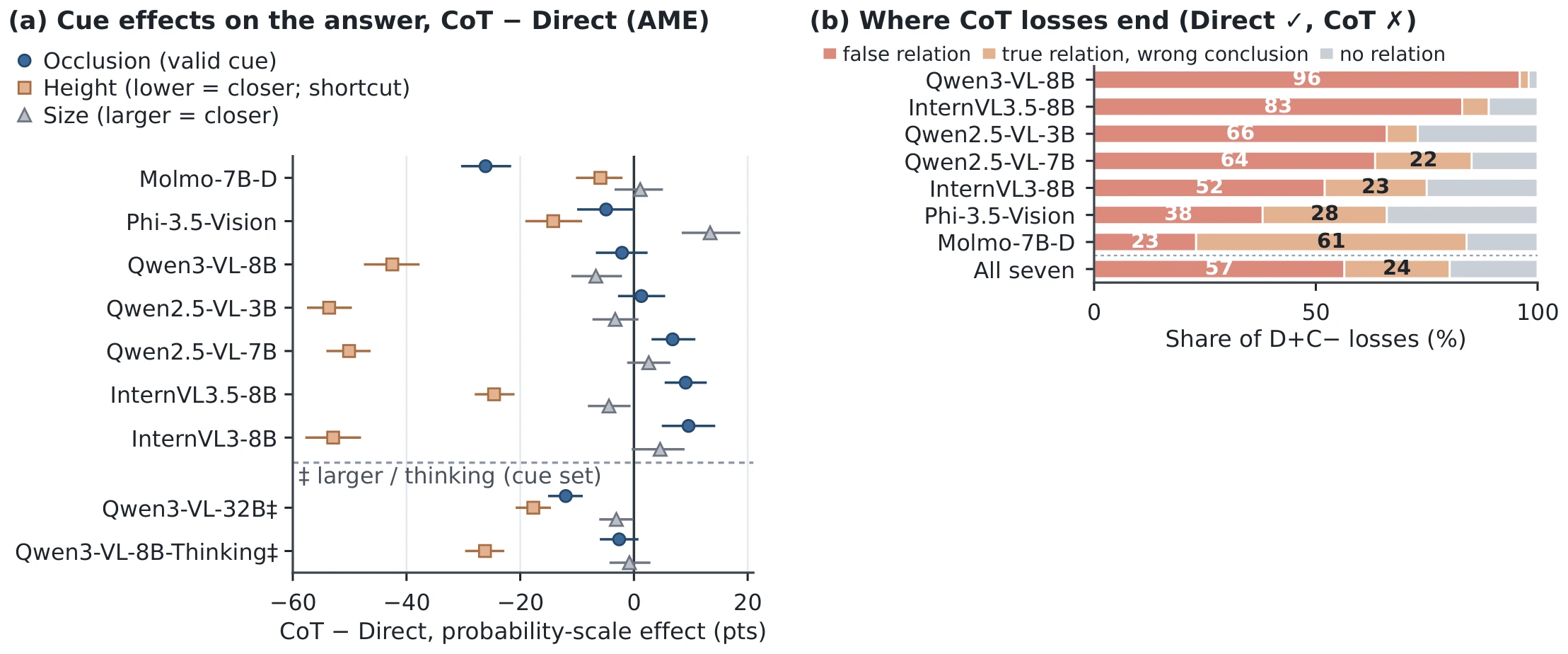
Generating a spatial rationale weakens reliance on a vertical-height shortcut across all 13 tested open models, but it also degrades valid depth cues and ends most CoT losses in a false written relation. On the 1,600-query cue-factorial set, where drawn size and vertical height are balanced so only occlusion T-junctions indicate depth, we estimate each visual cue’s average marginal effect (AME), the probability-scale change in the answer when that cue flips. Writing a rationale reduces the “lower is closer” height shortcut in all 13 cue-tested open models (by up to 53.6 pts AME), helping models whose Direct answers relied on height while degrading valid cues in models whose Direct answers already read occlusion or size.
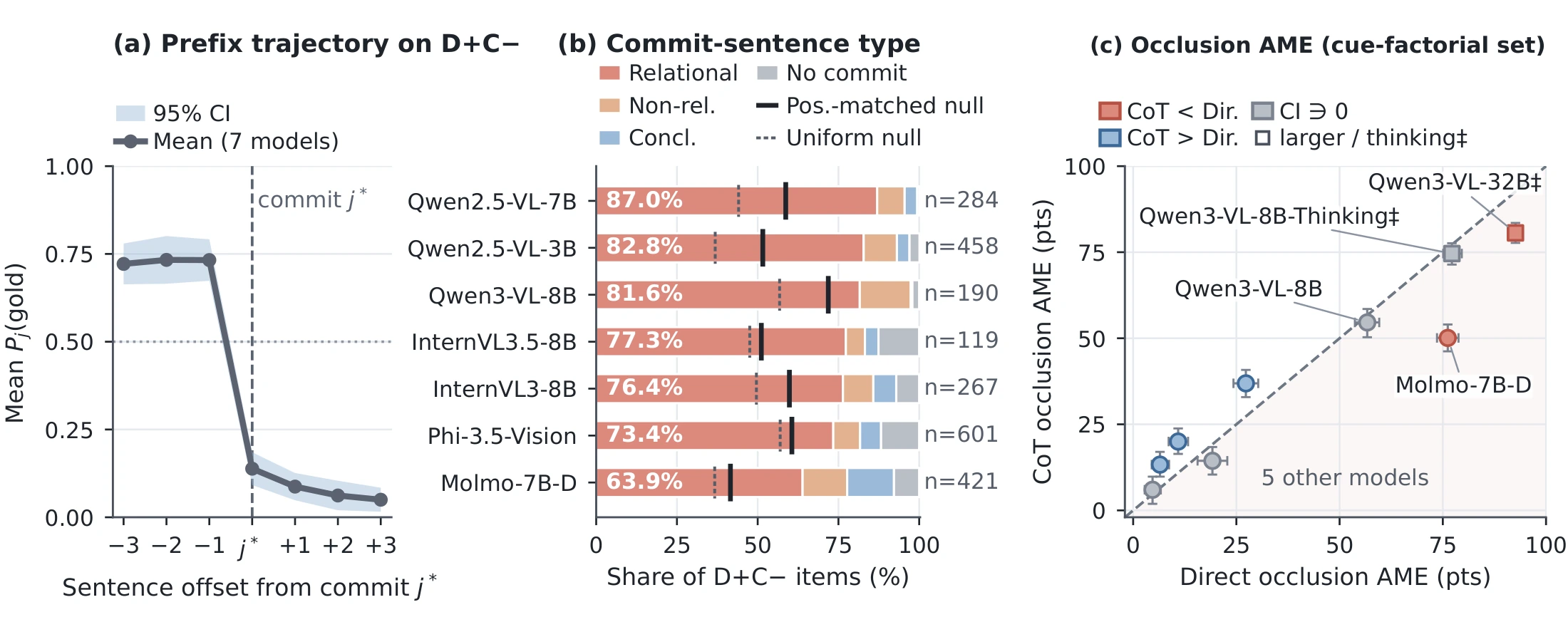
Final-answer occlusion AME falls in Molmo-7B-D (−26.1 pts, mainly at the concluding step; see Finding 3) and Qwen3-VL-32B (−12.0 pts), and on size-confounded Synthetic Depth, CoT lowers accuracy by 8.4–25.8 pts in 5 of 7 core models. Across all 3,014 D+C− losses on our three occlusion sets (the cue-factorial set, occlusion twins, and 431 visibly overlapping Synthetic Depth scenes), 56.6% end in a false written relation, including 145/145 relation-bearing losses in Qwen3-VL-32B.
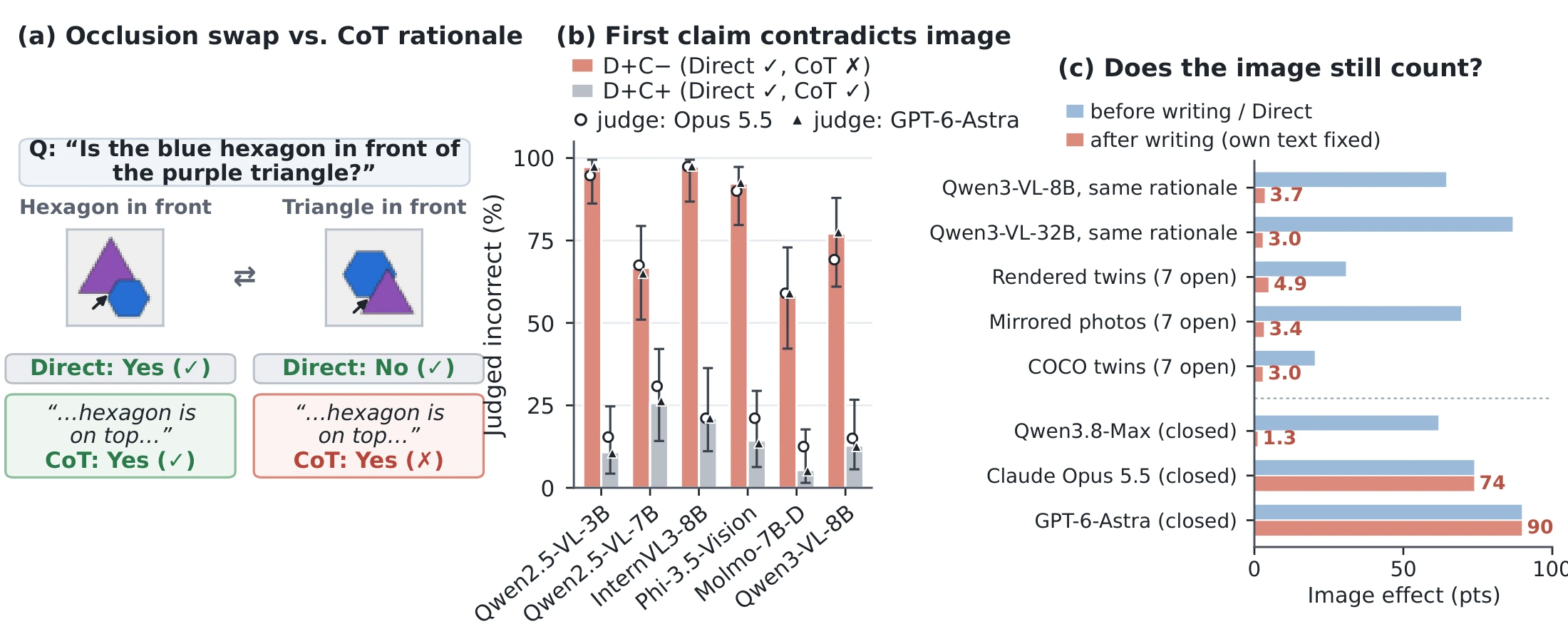
Two-judge visual contradiction audit and full 3-panel paper teaser
Two image-conditioned judges (Claude Opus 5.5 and GPT-6-Astra; κ = 0.91 against a 24-sentence human check) mark 88.0% of judgeable commit sentences on Synthetic Depth (431 overlapping scenes) as contradicting the image, compared with 9.4% of position-matched sentences from D+C+ rationales (first two-object claims across all 500 scenes: 58%–97% vs. 5%–26%). On the cue-factorial set, commit sentences contradict the image in 91.1% of audited Qwen3-VL-8B cases and 98.4% (vs. 1.9%) in Qwen3-VL-32B, compared with 37.4% in Molmo-7B-D. Among false body relations, 37.9% of all losses misread the occlusion overlap and 69.5% affirm the queried subject.
The answer follows the written relation
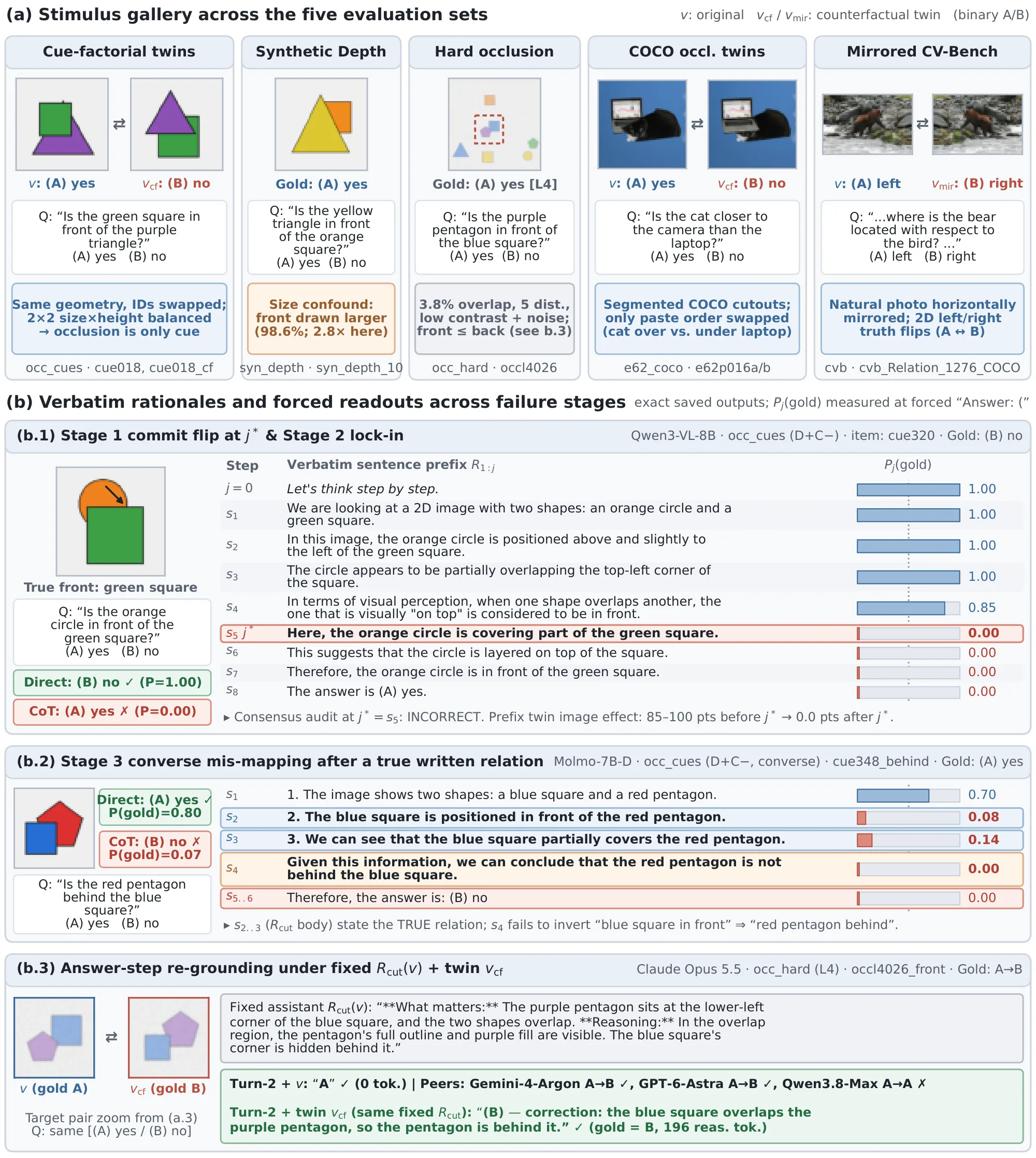
Once an open VLM writes a spatial relation, its final answer follows that sentence rather than the image, a behavior we call text lock-in. A coherent reasoner should agree with its own rationale, so the diagnostic test is whether the image still influences the answer after a relation is written. When we hold each model’s own conclusion-removed rationale (Rcut) fixed and swap in an opposite-depth image on rendered occlusion twins, natural-object COCO occlusion twins, or horizontally mirrored CV-Bench photographs, the image effect drops from 20.5–69.6 pts under Direct to 3.0–4.9 pts across the 7 core open models.
Image effect under Direct answering vs. fixed conclusion-removed rationale (Rcut)
First-claim edits, attention knockouts, and conclusion swaps
Replacing the first written claim with the true spatial relation and regenerating the rest of the rationale increases accuracy over Direct by +14.3 to +34.9 pts in 5 of 6 core models tested (Molmo-7B-D drops by 12.3 pts due to converse conclusion errors). In Qwen3-VL-32B (Direct 96.4% on items with a parsed claim), editing the first claim to the true vs. wrong relation moves accuracy to 99.2% vs. 17.6%.
Attention-edge knockouts at the forced answer prompt confirm that the answer is read from the written relation. Blocking attention to the image from all text positions flips only 2.1%–9.0% of answers after Rcut (compared with 26.6%–53.9% under Direct), whereas blocking attention from the answer prompt to the last written relation flips 10%–24% of answers (1.9–11× more per model).
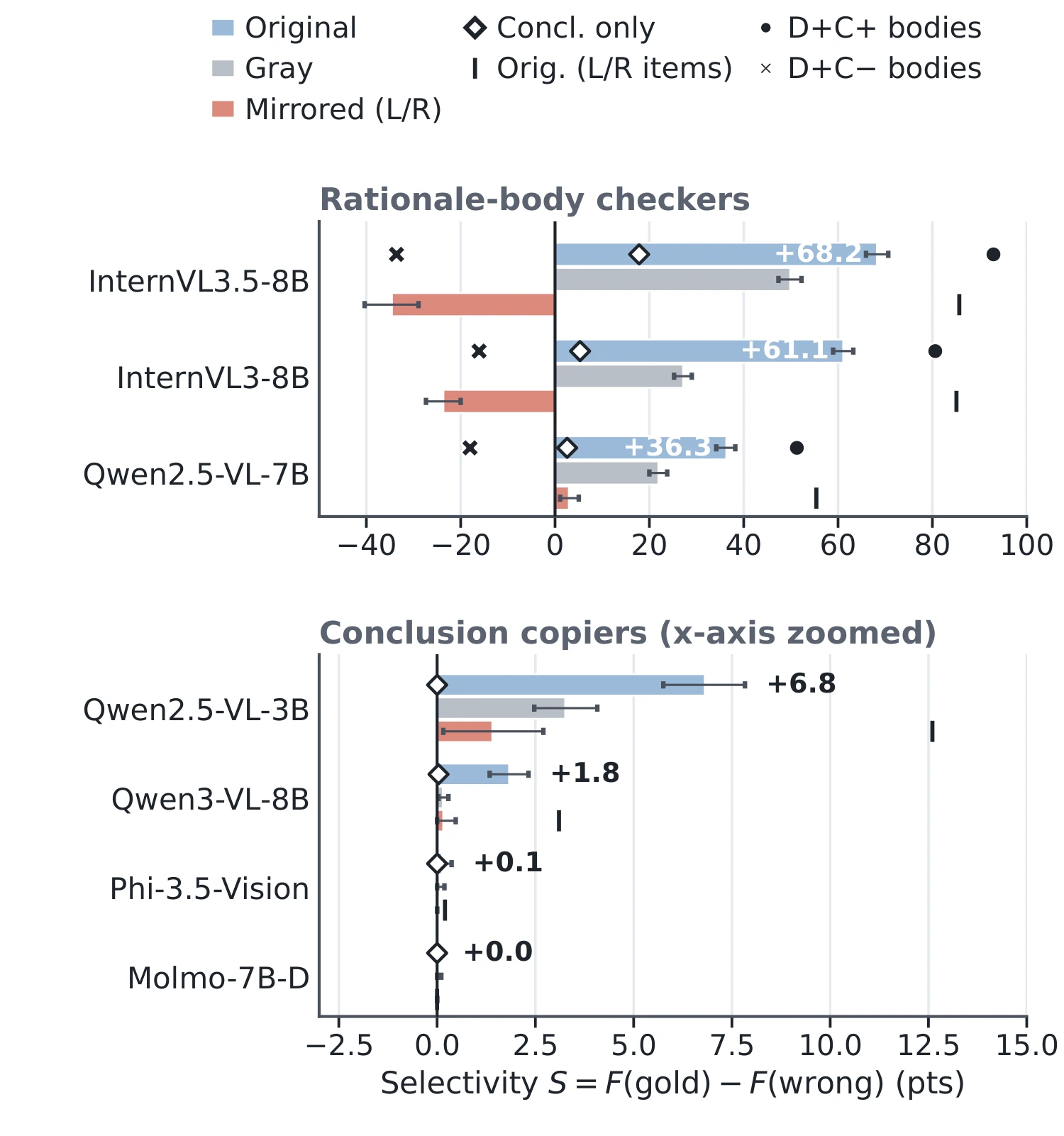
Appending a synthetic concluding sentence ("Therefore, the answer is (Y) …") after Rcut separates the seven core models into two groups. Conclusion copiers repeat whichever option letter the appended sentence names, whereas rationale-body checkers (InternVL3.5-8B, InternVL3-8B, and Qwen2.5-VL-7B) reject an appended conclusion that contradicts their rationale body and the image. When answering from their own unedited Rcut, however, rationale-body checkers still follow their written text: removing the image changes at most 1.2% of their 2D left/right answers.
Exploratory within-rationale prefix swap around j* and truncation sensitivity
Within the same D+C− rationales (an exploratory, selection-constrained test), swapping in the opposite-depth twin changes the forced readout by 64.6 pts right before the commit sentence j* vs. 3.7 pts right after it in Qwen3-VL-8B (86.9 → 3.0 pts in Qwen3-VL-32B). Replacing default Rcut with stricter truncation rules that also strip unlettered concluding clauses raises the rendered-twin image effect to 0.9–15.9 pts in the core seven models and 14.1–24.2 pts in Qwen3-VL-32B, which remains well below Direct in every model whose Direct answers use the image.
Conclusions mis-map true relations
Even when a rationale states a true spatial relation in its body, the concluding sentence can select the wrong answer option, a failure mode we call conclusion mis-mapping. Across the three occlusion sets, 23.8% of D+C− losses write a true body relation and then map it to the wrong option at the conclusion (18.9% question-to-relation mapping errors and 4.8% conclusion reversals), occurring mainly on converse questions whose subject order is inverted relative to the written relation.
The rationale writes “F is in front of K,” and the question asks “Is F in front of K?” The concluding step maps the relation to the right option.
The rationale writes “F is in front of K,” and the question asks “Is K behind F?” Inverting the subject order produces 12× more conclusion errors.
Conclusion mis-mapping is the main failure mode in Molmo-7B-D, where conclusion errors account for 61% of D+C− losses (46% mapping errors and 15% reversals). Even when we replace its commit sentence with the true claim “F is in front of K,” Molmo-7B-D answers accurately on direct restatements and negations (99.0% and 96.3%) but drops to 17.1% on the converse question “Is K behind F?” Combined, false written relations (56.6%) and mis-mapped conclusions (23.8%) account for four in five D+C− losses across the three occlusion sets.
When does short CoT help?
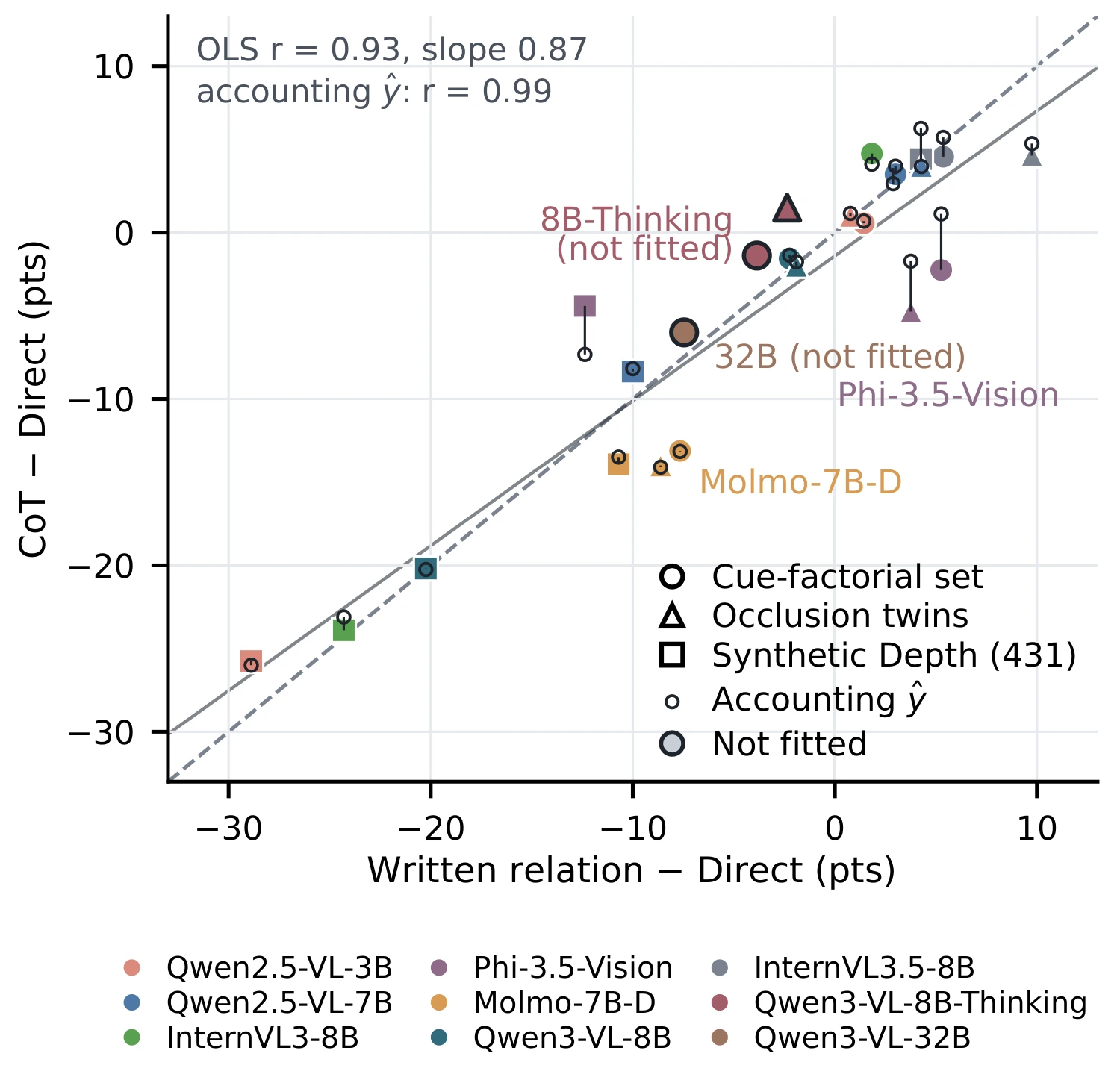
Because the final answer follows the written relation, short CoT improves accuracy when the written relation is more accurate than Direct answering and lowers accuracy when it is less accurate. On items where the rationale states a parsable spatial relation, the net CoT effect decomposes into two terms:
Here x = W − D is the accuracy of the written relation minus Direct accuracy, and A captures conclusion mis-mapping. Across 21 core model-by-dataset cells on the synthetic occlusion sets, x = W − D correlates with CoT − Direct at r = 0.93 (OLS slope 0.87; because both axes subtract Direct, a within-set shuffle of W gives r = 0.72, while including A in the accounting identity reaches r = 0.99). Qwen3-VL-32B and Qwen3-VL-8B-Thinking follow the same line when plotted out of sample.
On natural depth benchmarks (CV-Bench 3D Depth and BLINK Relative Depth), conclusion errors are rare (A ≈ 0), written relations are less accurate than Direct in 11 of 13 model-benchmark pairs, and x alone predicts CoT − Direct with a 1.3-pt MAE. On COCO occlusion twins, the sign of x matches the sign of CoT − Direct in all 8 open models tested (−2.9 to −4.9 pts when W < D vs. +1.0 to +5.5 pts when W > D).
Closed models re-check the image
Three of six frontier closed models override their own fixed rationale when a swapped image contradicts it, demonstrating answer-step re-grounding. We define answer-step re-grounding as checking the image again when producing the final answer so that visual evidence overrides a contradicting written claim. To test closed API models without token-level prefix forcing, we provide each model’s own conclusion-removed reply (Rcut) as Turn 1 and ask for the option letter alone in a new user turn (at the lowest available reasoning setting) while swapping in the opposite-depth twin image.
Six frontier closed models: Direct vs. fixed own rationale
Can open models learn to re-check the image?
In a pre-specified LoRA pilot on rendered scenes, fine-tuning Qwen3-VL-8B on its own fixed rationales with image-determined answer labels partly restores answer-step re-grounding on natural photographs. No label-free inference-time prompt intervention we tested beat Direct on average. We therefore ran a pre-specified LoRA pilot (rank 16, 1 epoch, cross-entropy loss on the answer letter only across 5,040 rendered-scene examples with zero evaluation overlap) comparing two training arms: MATCH, which pairs each conclusion-removed rationale with its own rendered image (where 13.3% of rationales naturally contradict the image because the base model erred), and CF, which pairs one rationale per twin pair with both opposite-depth images.
Qwen3-VL-8B LoRA pilot: natural-photo transfer & gray-image text adherence
Trained exclusively on rendered scenes, evaluated on natural photographs with the base model’s own Rcut held fixed.
1. COCO twins: fixed-Rcut image effect (pts)
Natural photos unseen in training (closer/farther wordings unseen; H1, with mirrored CV-Bench)
2. Mirrored CV-Bench: image effect (pts)
New natural photos (mirroring template appeared in training)
3. Gray image: follows base text (%)
Natural photos when vision is blank (COCO / CV-Bench; H4)
- Fixed rationales with image labels transfer to natural photos (H1–H3). Training on rendered scenes under MATCH raises the fixed-Rcut image effect from 2.9 to 51.7 pts on unseen COCO occlusion twins and from 1.3 to 90.7 pts on mirrored CV-Bench photos (whose left/right question template appeared in training). It also preserves held-out Direct accuracy (70.7% to 70.0%) and removes the main-pool CoT drop (base re-run −3.0 pts vs. −0.1 pts after training).
- Counterfactual twin pairing mainly teaches the model to discount text (H4). CF adds a modest gain in image effect over MATCH (+7.2 pts on COCO twins and +2.6 pts on mirrored CV-Bench), but under a blank gray image on natural photos, where only the written rationale is informative, CF follows the text on only 65.6% / 57.1% of items compared with 83.7% / 95.9% for MATCH.
- Caveat on rendered training-domain scenes. When evaluated with blank gray images on the rendered training-domain sets, both arms follow the text less often (MATCH 62.4% / 67.3%; CF 43.0% / 44.2%), so the pre-specified four-set pooled H4 endpoint (68.7% for MATCH and 47.3% for CF vs. 97.6% for the base model) is not met.
Full pre-specified pilot table (H1–H4 with 95% cluster-bootstrap CIs)
| Endpoint | Evaluation Set | Base (re-run) | MATCH | CF | CF − MATCH |
|---|---|---|---|---|---|
| H1: Image effect, base Rcut fixed (pts) | COCO twins | 2.9 | 51.7 | 58.9 | +7.2 [+5.0, +9.5] |
| Mirrored CV-Bench | 1.3 | 90.7 | 93.4 | +2.6 [0.0, +6.0] | |
| H2: Direct accuracy (%) | Natural pooled (4,015) | 81.3 | 84.4 | 84.2 | −0.2 [−0.9, +0.4] |
| Held-out pool (767) | 70.7 | 70.0 | 68.8 | −1.2 [−3.0, +0.4] | |
| H3: Own CoT − Direct (pts) base model re-run with regenerated CoT |
Main pool / Cue set | −3.0 / −1.5 | −0.1 / −0.1 | +0.1 / 0.0 | +0.2 / +0.1 |
| H4: Gray image, follows base text (%) | COCO twins (326) | 96.3 | 83.7 | 65.6 | −18.1 [−22.9, −12.8] |
| (natural photos vs. 4-set pooled) | Mirrored CV-Bench (147) | 100.0 | 95.9 | 57.1 | −38.8 [−46.6, −31.3] |
| Four sets pooled (2,402) | 97.6 | 68.7 | 47.3 | −21.4 [−23.1, −19.8] |
Note: The −3.5 pt main-pool CoT difference for Qwen3-VL-8B in Table 1 uses stored paper rationales, whereas the Base (re-run) row here (−3.0 pts) re-evaluates the untuned base model with freshly generated rationales under the shared pilot evaluation script.
Verbatim rationales and COCO occlusion twins
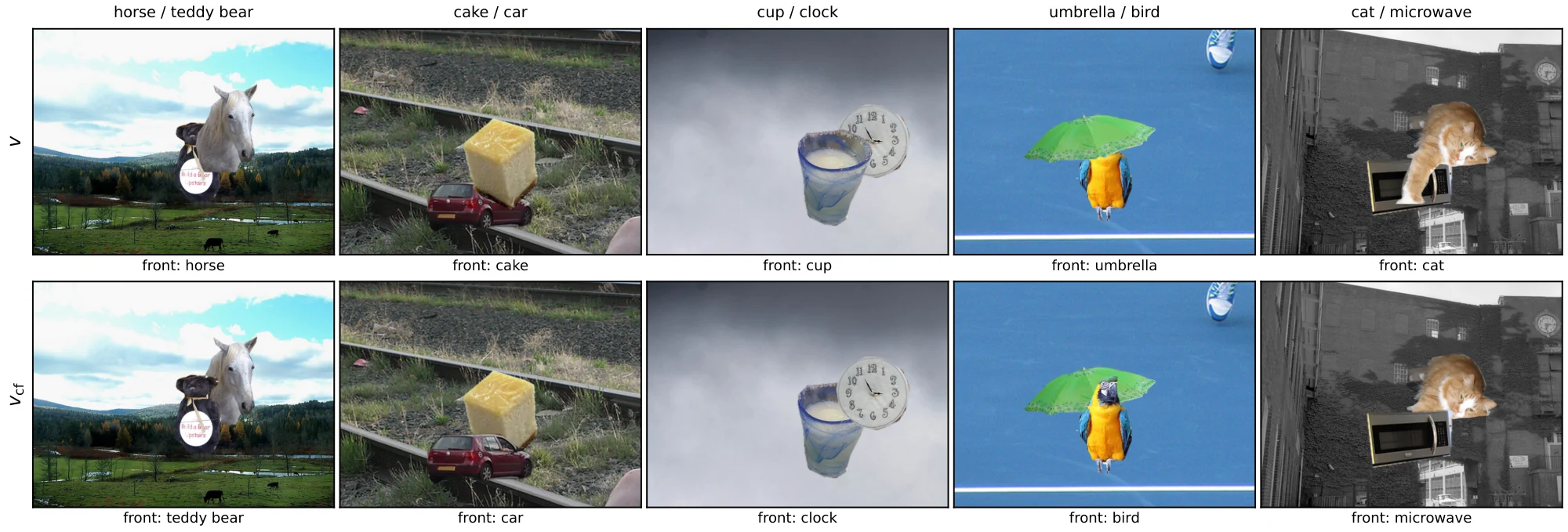
We show verbatim generated rationales with sentence-by-sentence forced readouts Pj(gold) for three representative cases, followed by examples from our natural-object COCO occlusion twins.
View full paper stimulus & verbatim trace plate
BibTeX
If you find this work or our diagnostic datasets useful, please cite our paper:
@article{zhang2026seeing,
  title   = {Seeing Right, Writing Wrong: Where Short Chain-of-Thought Breaks Spatial {VQA}},
  author  = {Zhang, Chenhao},
  journal = {arXiv preprint arXiv:2611.28665},
  year    = {2026}
}